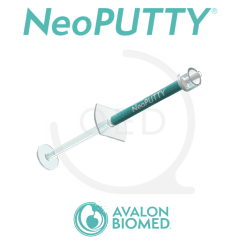
NeoPUTTY® · Avalon Biomed · 0.5 g syringe
Nobody's clinical result was ever improved by the mixing. Powder, gel, glass slab, consistency judged by eye, working time already ticking – every step is a chance for the material to leave the pad different from the way it left the jar. NeoPUTTY® arrives ready. You dispense what the cavity needs, place it, and the variable you were managing at the bench is simply not there.
| 97.1% CLINICAL, 12 MO | 92.8% RADIOGRAPHIC | 1 hr+ WORKING TIME |
This pack (REF ANPIK): 0.5 g NeoPUTTY® premixed bioceramic putty, syringe delivery · about six doses at the 0.075 g Avalon quote for an anterior pulpotomy
Made by Avalon Biomed · 3-year shelf life, and it does not dry out between uses
Most of what gets claimed for bioceramics comes from cell culture and extracted teeth. NeoPUTTY® has something almost nothing else in this category has: a randomised controlled trial in patients. Pediatric Dentistry, 2023 – 70 primary molars in 42 children, twelve months, against NeoMTA® 2, assessed by two independent evaluators.
| Clinical success | 97.1% (34 of 35) for NeoPUTTY®, against 100% (34 of 34) for NeoMTA® 2 |
| Radiographic | 92.8% (32 of 35) for NeoPUTTY®, against 94.1% (32 of 34) for NeoMTA® 2 |
| Authors' finding | NeoPUTTY® showed comparable success to mineral trioxide aggregate over twelve months |
“NeoPUTTY® showed a comparable success to mineral trioxide aggregate in primary molar pulpotomies over 12 months.”
Alqahtani AS, Alsuhaibani NN, Sulimany AM, Bawazir OA. Pediatric Dentistry 2023;45(3):240–244.
That is a primary molar result at twelve months, and it does not claim superiority over MTA. What it establishes is the question that actually matters about a premixed material: the convenience costs you nothing measurable.
The grey shadow older MTAs leave in an anterior tooth comes from bismuth oxide, the traditional radiopacifier. Avalon use tantalum oxide (tantalite) instead and market NeoPUTTY® as never discolouring. We would rather give you the measured figures – there are now two independent ones.
Independent spectrophotometry on 96 extracted anterior teeth, followed to twelve months, put NeoPutty in saline at a colour change of Delta E 2.26 – alongside Biodentine™ at 2.18, and far below ProRoot® MTA contaminated with blood at 7.42. Small, and measured rather than asserted – which is more than the category usually offers. The same study makes a point no radiopacifier can fix: blood contamination worsened colour stability in every material tested. Achieve haemostasis first, whatever you are placing.
Özüdogru S, Düzyol E, Türkoglu Kayaci S, Aly Ahmed HM, Arslan H. Journal of Clinical Pediatric Dentistry 2026;50(1):236–244.
A second group looked at what your irrigants do to it. Testing Biodentine™ and NeoPutty against EDTA, chlorhexidine, HEDP and sodium hypochlorite, they found Biodentine™ discoloured more against every solution except distilled water, and concluded NeoPutty “could be an appropriate material in aesthetic areas”. The takeaway is about protocol: chlorhexidine and sodium hypochlorite discoloured both materials most.
Usta SN, Keskin C. Restorative Dentistry & Endodontics 2024;49:e25.
| Chemistry | Hydraulic calcium silicate – tricalcium and dicalcium silicate, the same family as MTA, supplied premixed as a putty |
| Radiopacifier | Tantalum oxide (tantalite), not bismuth oxide – which is what removes the classic bismuth discolouration mechanism |
| Delivery | Syringe. Dispense what the cavity takes and recap – no slab, no spatula, no discarded excess from a batch mixed too large |
| Sets in ~5 hours | In vivo, in the presence of moisture – but it is immediately washout resistant, so it stays where you put it while you finish the procedure |
| 8.1 mm Al | Radiopacity Avalon describe as the highest in the premixed bioceramic putty class – comfortably above the ISO 6876 minimum of 3 mm |
| Cytocompatibility | Comparable to NeoMTA® Plus and MTA Angelus® on human dental pulp cells (Lozano-Guillén et al, Clin Oral Investig 2022) |
Because it is water-free until it meets the tooth, NeoPUTTY® gives over an hour of working time and sets in about five hours in vivo. It will not go off on the pad while you deal with something else – and it needs contact with moisture, from apical tissue, tubules or pulp, to set at all.
The kits contain no applicator tip, which surprises people. Express what you need onto a pad and carry it with what you already use – Avalon suggest a plastics instrument, a Hollenbach, an amalgam carrier or an MTA carrier. For apexification, a reversed paper point guides the putty to the apex.
On thickness, Avalon are specific: at least 1.5 mm for a pulpotomy, liner, base or pulp cap, and a 3–5 mm apical barrier for apexification.
Avalon list twelve indications. The ones that bring people to the material are pulpotomy – what the randomised trial tested – direct and indirect pulp capping, cavity liner and base, apexogenesis and apexification, perforation repair, resorption, root-end filling and obturation. Read the instructions for use before each new application.
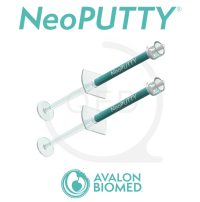
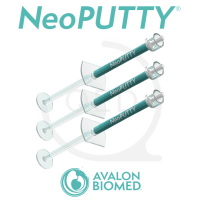
This is the 0.5 g syringe – the only size Avalon supply, and the sensible way in. If it becomes routine, we sell it in twos and threes at a lower cost per gram – sealed spares, not a bigger syringe, which is the better arrangement when shelf life runs from opening.
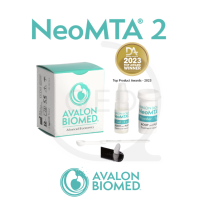
One honest reason to choose the powder-and-gel NeoMTA® 2 instead: you can mix it thin, from putty to a sealer-like consistency, which a premixed putty cannot do. NeoPUTTY® answers with radiopacity – 8.1 mm Al against 6.5, about 25% higher on Avalon's own comparison.
| Multipacks | Two syringes (1.0 g) and three (1.5 g) · better value per gram |
| Mixable sibling | NeoMTA® 2 1.0 g Kit · putty or sealer consistency from one powder |
| Try both | NeoSEALER® Flo & NeoPUTTY® Kit · sealer and putty in one box |
| Carrying it | Vista MTA carrier · for root-end and perforation work |
| Obturating | NeoSEALER® Flo · the matching bioceramic sealer |
| Between visits | BIO-C® TEMP · ready-to-use intracanal dressing |
| Isolation | OraSeal® Caulking · a dry field before any calcium silicate |
Is a premixed putty really as good as mixing it myself?
On the one indication tested in a randomised trial, yes – 97.1% against 100% clinical success at twelve months, one tooth in thirty-five. What you lose is the ability to vary the consistency; what you gain is that every increment is identical, and over an hour to place it.
How many doses will 0.5 g give me?
About six, on Avalon's figure of 0.075 g for a typical anterior pulpotomy. Scale it to your own work – a 3–5 mm apical barrier for apexification is a much larger increment than a pulp cap.
Can I use it in a primary tooth with a permanent successor?
Check the instructions for use for the indication in front of you. Avalon's bioceramic sealers are specifically contraindicated there; do not assume the putty's indications match the sealer's.
Five hours to set – can I restore before then?
Yes, and Avalon say so directly: you can complete the restoration or cement a crown immediately after placing it. Setting and washout resistance are different things – NeoPUTTY® is immediately washout resistant and, per Avalon, dimensionally stable with zero shrinkage, so it stays put while the set completes.
NeoPUTTY® 0.5 gm Kit · premixed bioceramic putty · tricalcium and dicalcium silicate · tantalite radiopacifier · 8.1 mm Al · over 1 hr working time · sets ~5 hrs · 12 indications · Avalon Biomed · REF ANPIK
NeoPUTTY® · Avalon Biomed · 0.5 g syringe
Nobody's clinical result was ever improved by the mixing. Powder, gel, glass slab, consistency judged by eye, working time already ticking – every step is a chance for the material to leave the pad different from the way it left the jar. NeoPUTTY® arrives ready. You dispense what the cavity needs, place it, and the variable you were managing at the bench is simply not there.
| 97.1% CLINICAL, 12 MO | 92.8% RADIOGRAPHIC | 1 hr+ WORKING TIME |
This pack (REF ANPIK): 0.5 g NeoPUTTY® premixed bioceramic putty, syringe delivery · about six doses at the 0.075 g Avalon quote for an anterior pulpotomy
Made by Avalon Biomed · 3-year shelf life, and it does not dry out between uses
Most of what gets claimed for bioceramics comes from cell culture and extracted teeth. NeoPUTTY® has something almost nothing else in this category has: a randomised controlled trial in patients. Pediatric Dentistry, 2023 – 70 primary molars in 42 children, twelve months, against NeoMTA® 2, assessed by two independent evaluators.
| Clinical success | 97.1% (34 of 35) for NeoPUTTY®, against 100% (34 of 34) for NeoMTA® 2 |
| Radiographic | 92.8% (32 of 35) for NeoPUTTY®, against 94.1% (32 of 34) for NeoMTA® 2 |
| Authors' finding | NeoPUTTY® showed comparable success to mineral trioxide aggregate over twelve months |
“NeoPUTTY® showed a comparable success to mineral trioxide aggregate in primary molar pulpotomies over 12 months.”
Alqahtani AS, Alsuhaibani NN, Sulimany AM, Bawazir OA. Pediatric Dentistry 2023;45(3):240–244.
That is a primary molar result at twelve months, and it does not claim superiority over MTA. What it establishes is the question that actually matters about a premixed material: the convenience costs you nothing measurable.
The grey shadow older MTAs leave in an anterior tooth comes from bismuth oxide, the traditional radiopacifier. Avalon use tantalum oxide (tantalite) instead and market NeoPUTTY® as never discolouring. We would rather give you the measured figures – there are now two independent ones.
Independent spectrophotometry on 96 extracted anterior teeth, followed to twelve months, put NeoPutty in saline at a colour change of Delta E 2.26 – alongside Biodentine™ at 2.18, and far below ProRoot® MTA contaminated with blood at 7.42. Small, and measured rather than asserted – which is more than the category usually offers. The same study makes a point no radiopacifier can fix: blood contamination worsened colour stability in every material tested. Achieve haemostasis first, whatever you are placing.
Özüdogru S, Düzyol E, Türkoglu Kayaci S, Aly Ahmed HM, Arslan H. Journal of Clinical Pediatric Dentistry 2026;50(1):236–244.
A second group looked at what your irrigants do to it. Testing Biodentine™ and NeoPutty against EDTA, chlorhexidine, HEDP and sodium hypochlorite, they found Biodentine™ discoloured more against every solution except distilled water, and concluded NeoPutty “could be an appropriate material in aesthetic areas”. The takeaway is about protocol: chlorhexidine and sodium hypochlorite discoloured both materials most.
Usta SN, Keskin C. Restorative Dentistry & Endodontics 2024;49:e25.
| Chemistry | Hydraulic calcium silicate – tricalcium and dicalcium silicate, the same family as MTA, supplied premixed as a putty |
| Radiopacifier | Tantalum oxide (tantalite), not bismuth oxide – which is what removes the classic bismuth discolouration mechanism |
| Delivery | Syringe. Dispense what the cavity takes and recap – no slab, no spatula, no discarded excess from a batch mixed too large |
| Sets in ~5 hours | In vivo, in the presence of moisture – but it is immediately washout resistant, so it stays where you put it while you finish the procedure |
| 8.1 mm Al | Radiopacity Avalon describe as the highest in the premixed bioceramic putty class – comfortably above the ISO 6876 minimum of 3 mm |
| Cytocompatibility | Comparable to NeoMTA® Plus and MTA Angelus® on human dental pulp cells (Lozano-Guillén et al, Clin Oral Investig 2022) |
Because it is water-free until it meets the tooth, NeoPUTTY® gives over an hour of working time and sets in about five hours in vivo. It will not go off on the pad while you deal with something else – and it needs contact with moisture, from apical tissue, tubules or pulp, to set at all.
The kits contain no applicator tip, which surprises people. Express what you need onto a pad and carry it with what you already use – Avalon suggest a plastics instrument, a Hollenbach, an amalgam carrier or an MTA carrier. For apexification, a reversed paper point guides the putty to the apex.
On thickness, Avalon are specific: at least 1.5 mm for a pulpotomy, liner, base or pulp cap, and a 3–5 mm apical barrier for apexification.
Avalon list twelve indications. The ones that bring people to the material are pulpotomy – what the randomised trial tested – direct and indirect pulp capping, cavity liner and base, apexogenesis and apexification, perforation repair, resorption, root-end filling and obturation. Read the instructions for use before each new application.
This is the 0.5 g syringe – the only size Avalon supply, and the sensible way in. If it becomes routine, we sell it in twos and threes at a lower cost per gram – sealed spares, not a bigger syringe, which is the better arrangement when shelf life runs from opening.
One honest reason to choose the powder-and-gel NeoMTA® 2 instead: you can mix it thin, from putty to a sealer-like consistency, which a premixed putty cannot do. NeoPUTTY® answers with radiopacity – 8.1 mm Al against 6.5, about 25% higher on Avalon's own comparison.
| Multipacks | Two syringes (1.0 g) and three (1.5 g) · better value per gram |
| Mixable sibling | NeoMTA® 2 1.0 g Kit · putty or sealer consistency from one powder |
| Try both | NeoSEALER® Flo & NeoPUTTY® Kit · sealer and putty in one box |
| Carrying it | Vista MTA carrier · for root-end and perforation work |
| Obturating | NeoSEALER® Flo · the matching bioceramic sealer |
| Between visits | BIO-C® TEMP · ready-to-use intracanal dressing |
| Isolation | OraSeal® Caulking · a dry field before any calcium silicate |
Is a premixed putty really as good as mixing it myself?
On the one indication tested in a randomised trial, yes – 97.1% against 100% clinical success at twelve months, one tooth in thirty-five. What you lose is the ability to vary the consistency; what you gain is that every increment is identical, and over an hour to place it.
How many doses will 0.5 g give me?
About six, on Avalon's figure of 0.075 g for a typical anterior pulpotomy. Scale it to your own work – a 3–5 mm apical barrier for apexification is a much larger increment than a pulp cap.
Can I use it in a primary tooth with a permanent successor?
Check the instructions for use for the indication in front of you. Avalon's bioceramic sealers are specifically contraindicated there; do not assume the putty's indications match the sealer's.
Five hours to set – can I restore before then?
Yes, and Avalon say so directly: you can complete the restoration or cement a crown immediately after placing it. Setting and washout resistance are different things – NeoPUTTY® is immediately washout resistant and, per Avalon, dimensionally stable with zero shrinkage, so it stays put while the set completes.
NeoPUTTY® 0.5 gm Kit · premixed bioceramic putty · tricalcium and dicalcium silicate · tantalite radiopacifier · 8.1 mm Al · over 1 hr working time · sets ~5 hrs · 12 indications · Avalon Biomed · REF ANPIK
SpotlightRECIPROC® MinimaOne file · slim shaping for narrow canals
Shaping systems
Hand files & finders
Materials & more